
What Is a Sales Funnel? The Complete Guide
Affiliate Disclosure: This post contains affiliate links. If you purchase through these links, we may earn a commission at no extra cost to you. We only recommend tools we've researched thoroughly.
Definition
A sales funnel is the step-by-step journey a potential customer takes from first discovering your business to making a purchase. It's called a "funnel" because the number of people narrows at each stage — many people become aware of your product, fewer show interest, even fewer make a decision, and only a fraction take action and buy.
Understanding your sales funnel lets you identify where you're losing potential customers and fix those leaks to increase revenue.
Quick Answer
A sales funnel maps the customer journey through four stages: Awareness (they discover you), Interest (they engage with your content), Decision (they evaluate your offer), and Action (they purchase). Every business has a sales funnel, whether intentional or not. Building one deliberately — with targeted content, landing pages, and follow-up sequences at each stage — dramatically improves conversion rates.
The 4 Stages of a Sales Funnel
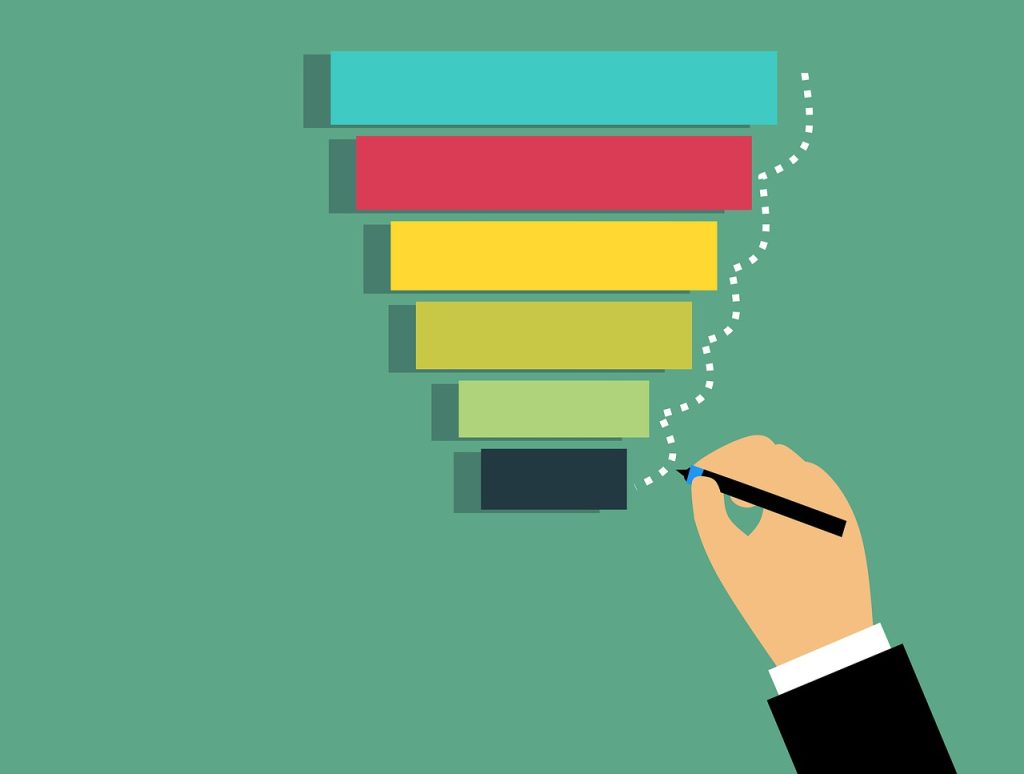
Think of a sales funnel as an inverted pyramid. The widest point at the top represents everyone who becomes aware of your business. The narrow point at the bottom represents paying customers.
Stage 1: Awareness (Top of Funnel — TOFU)
What happens: A potential customer learns your business exists for the first time.
How they find you:
- Search engine results (Google, Bing)
- Social media posts or ads
- Word of mouth or referrals
- Blog content or videos
- Podcast appearances
- Paid advertising (Google Ads, Facebook Ads)
Your goal at this stage: Get attention and make a strong first impression. You're not selling yet — you're providing value and establishing relevance.
Content examples:
- Blog posts answering common questions in your industry
- Short-form social media content (TikTok, Instagram Reels)
- YouTube tutorials or educational videos
- Infographics and shareable resources
- Podcast episodes
Key metric: Reach and traffic — how many people are entering the top of your funnel?
Stage 2: Interest (Middle of Funnel — MOFU)
What happens: The potential customer is engaged. They've read your content, followed your social media, or signed up for your email list. They're learning more about the problem you solve and considering whether your approach resonates with them.
Signals of interest:
- Subscribing to your email newsletter
- Downloading a free resource (lead magnet)
- Following your social media accounts
- Reading multiple blog posts or watching multiple videos
- Joining a webinar or free workshop
Your goal at this stage: Build trust and demonstrate expertise. Help them understand their problem more clearly and position your solution as a natural fit.
Content examples:
- Email sequences that educate and build rapport
- Case studies showing results you've achieved
- Webinars or live Q&A sessions
- Comparison guides and buying guides
- Free tools or calculators
Key metric: Engagement and lead capture — how many visitors are becoming subscribers or leads?
Stage 3: Decision (Bottom of Funnel — BOFU)
What happens: The potential customer is actively evaluating whether to buy from you. They're comparing options, reading reviews, and looking for reassurance that they're making the right choice.
Signals of decision-making:
- Visiting your pricing page
- Reading testimonials and case studies
- Requesting a demo or consultation
- Adding items to a cart
- Asking specific questions about features or implementation
Your goal at this stage: Remove objections, provide social proof, and make the purchasing decision as easy as possible.
Content examples:
- Product demos and walkthroughs
- Customer testimonials and success stories
- Detailed pricing breakdowns with comparisons
- FAQ pages addressing common objections
- Limited-time offers or bonuses
- Free trials or money-back guarantees
Key metric: Conversion rate — what percentage of interested leads are moving toward purchase?
Stage 4: Action (Bottom of Funnel)
What happens: The customer makes a purchase, signs up, or completes the desired action.
Your goal at this stage: Make the transaction seamless and immediately begin the retention process.
What to include:
- A clean, simple checkout process (every extra field reduces conversions)
- Order confirmation with clear next steps
- Onboarding email sequence
- Upsell or cross-sell offers (used sparingly)
- A request for feedback or review
Key metric: Revenue and customer acquisition cost (CAC) — how much did it cost to acquire this customer, and what are they worth?
What happens after action: The funnel doesn't end at purchase. The best businesses add a fifth unofficial stage — Retention and Advocacy — where happy customers become repeat buyers and refer others, feeding new people into the top of the funnel.
Real-World Sales Funnel Examples
Example 1: Online Course Creator
| Stage | What Happens |
|---|---|
| Awareness | Potential student finds a YouTube video about productivity |
| Interest | They download a free "Weekly Planner Template" (lead magnet) and join the email list |
| Decision | They receive a 5-email sequence sharing productivity tips, each mentioning the paid course. They watch a free webinar demonstrating the course content |
| Action | They purchase the $197 course using a limited-time $50 discount offered in the webinar follow-up email |
Example 2: SaaS Company (B2B)
| Stage | What Happens |
|---|---|
| Awareness | Marketing manager searches "best project management tool" and finds a comparison blog post |
| Interest | They sign up for a 14-day free trial after reading the post |
| Decision | They receive onboarding emails, attend a product demo, and discuss pricing with a sales representative |
| Action | Their company signs up for the annual plan at $99/user/month |
Example 3: Local Service Business
| Stage | What Happens |
|---|---|
| Awareness | Homeowner searches "plumber near me" and finds the company's Google Business listing |
| Interest | They visit the website, read reviews, and see a "Free Estimate" call-to-action |
| Decision | They request a free estimate. The plumber follows up with an SMS message and a phone call to schedule |
| Action | The homeowner books the service after receiving a clear written quote |
How to Build Your First Sales Funnel (Step by Step)
Step 1: Define Your Target Customer
Before building anything, get clear on who you're trying to reach. Answer these questions:
- What problem do they have that your product or service solves?
- Where do they spend time online? (Which social platforms, forums, or publications?)
- What objections will they have before buying?
- What's their budget and decision-making process?
Write a one-paragraph description of your ideal customer. Every funnel decision should serve this person.
Step 2: Create a Lead Magnet
A lead magnet is a free resource you offer in exchange for someone's email address. It bridges the gap between Awareness and Interest. Effective lead magnets include:
- PDF guides or checklists
- Templates or swipe files
- Free mini-courses (3-5 short lessons)
- Calculators or assessment tools
- Free trials of your product
The key rule: Your lead magnet should solve a specific, immediate problem related to the bigger problem your paid product addresses.
Step 3: Build a Landing Page
Your landing page has one job: convince visitors to download your lead magnet (or take the next step). Essential elements:
- A clear, benefit-focused headline
- 2-3 bullet points explaining what they'll get
- A simple form (name and email — nothing more)
- Social proof (testimonial, download count, or trust badges)
- No navigation menu — remove distractions
Tools for building landing pages: GoHighLevel, ClickFunnels, Systeme.io, or Leadpages. See our Best Sales Funnel Builders comparison for detailed reviews of each.
Step 4: Set Up an Email Sequence
Once someone downloads your lead magnet, they should receive an automated email sequence that builds trust and leads toward your paid offer. A basic 5-email sequence:
- Email 1 (immediately): Deliver the lead magnet + welcome message
- Email 2 (day 2): Share a useful tip related to the lead magnet topic
- Email 3 (day 4): Tell a story about a customer's transformation
- Email 4 (day 6): Address the #1 objection to your product
- Email 5 (day 8): Present your offer with a clear call to action
Step 5: Create Your Sales Page
For leads who click through from your email sequence, you need a dedicated sales page. This page should:
- Open with the problem your audience faces
- Present your solution and explain how it works
- Include social proof (testimonials, case studies, results)
- List features and benefits clearly
- State the price with context (compare to the cost of the problem)
- Include a strong guarantee (money-back, satisfaction, etc.)
- End with a clear call to action
Step 6: Drive Traffic to Your Landing Page
Your funnel is built — now people need to enter it. Start with 1-2 traffic sources and master them:
- Organic search (SEO): Write blog posts targeting keywords your audience searches for
- Social media: Share valuable content on the platforms where your audience spends time
- Paid advertising: Run targeted ads on Facebook, Instagram, Google, or YouTube
- Partnerships: Guest post, podcast appearances, or joint webinars with complementary brands
Step 7: Measure and Optimise
Track these metrics at each funnel stage:
| Metric | What It Tells You |
|---|---|
| Traffic | How many people are entering your funnel |
| Opt-in rate | What percentage of visitors become leads (target: 20-40%) |
| Email open rate | Whether your subject lines are working (target: 25-40%) |
| Click-through rate | Whether your emails drive action (target: 2-5%) |
| Conversion rate | What percentage of leads become customers (target: 1-5%) |
| Customer acquisition cost | How much you're spending to acquire each customer |
Optimise the lowest-performing stage first — that's your biggest leverage point.
What Tools Do You Need to Build a Sales Funnel?
At minimum, you need:
- A landing page builder — to create opt-in and sales pages
- An email marketing platform — to send automated sequences
- A traffic source — organic content or paid ads
You can use separate tools for each, or choose an all-in-one platform:
| Approach | Tools | Monthly Cost |
|---|---|---|
| All-in-one (budget) | Systeme.io | Free – $97/mo |
| All-in-one (full-featured) | GoHighLevel | $97 – $297/mo |
| Dedicated funnel builder | ClickFunnels | $97 – $297/mo |
| Landing pages + email | Leadpages + GetResponse | $53 – $111/mo |
For a complete comparison of funnel building tools, read our Best Sales Funnel Builders in 2026 guide.
Common Sales Funnel Mistakes to Avoid
- Skipping the lead magnet — Asking for a purchase before building trust. Always give value first.
- Too many steps — Every additional page or form field loses people. Keep funnels as short as possible.
- Ignoring mobile — Over 60% of web traffic is mobile. Test every funnel page on a phone.
- No follow-up — Most people don't buy on the first visit. Email sequences are essential.
- Generic messaging — "We offer great service" means nothing. Speak to a specific problem and a specific audience.
- Not tracking metrics — If you're not measuring each stage, you can't improve. Set up analytics from day one.
- Building before defining the customer — A beautiful funnel for the wrong audience converts at zero.
FAQ
How long does it take to build a sales funnel?
A basic sales funnel (landing page, lead magnet, 5-email sequence, sales page) can be built in 1-2 days using a tool like Systeme.io or ClickFunnels. A more complex funnel with multiple traffic sources, A/B testing, and advanced automations typically takes 1-2 weeks. The funnel itself is just the start — optimising it based on data is an ongoing process.
How much does a sales funnel cost to set up?
You can build a sales funnel for free using Systeme.io's free plan. Paid tools range from $27/month (Systeme.io Startup) to $297+/month (GoHighLevel Unlimited or ClickFunnels Pro). Add paid advertising costs if you're driving traffic through ads — most small businesses start with $5-20/day on Facebook or Google Ads.
What is the difference between a sales funnel and a marketing funnel?
The terms are often used interchangeably, but technically a marketing funnel covers the full journey from awareness to consideration, while a sales funnel focuses specifically on the stages from consideration to purchase. In practice, most businesses use "sales funnel" to describe the entire journey from first touch to conversion.
Do I need a sales funnel if I sell on Amazon or Etsy?
A sales funnel can still benefit marketplace sellers. While Amazon and Etsy handle the checkout process, a funnel helps you build an email list of customers (which you own, unlike marketplace followers), promote new products directly, and reduce dependence on a single marketplace's algorithm.
What is the most important part of a sales funnel?
The follow-up sequence. Most visitors won't buy on their first visit — industry data suggests it takes 5-12 touchpoints before a purchase decision. Your email sequence (and SMS, if applicable) is what converts interested visitors into paying customers over time. A mediocre landing page with great follow-up will outperform a perfect landing page with no follow-up.
Can a sales funnel work for service businesses?
Absolutely. Service businesses benefit enormously from sales funnels. A typical service funnel: blog post or ad (awareness) → free consultation booking page (interest) → consultation call (decision) → proposal and contract (action). Adding automated SMS reminders and follow-ups through a tool like GoHighLevel is especially effective for service businesses.
What is a sales funnel builder?
A sales funnel builder is software that helps you create the pages, forms, email sequences, and automations that make up a sales funnel — without needing to code. Popular options include GoHighLevel, ClickFunnels, Systeme.io, and Leadpages. For a complete comparison, see our Best Sales Funnel Builders in 2026 guide.
How do I know if my sales funnel is working?
Track three core metrics: opt-in rate (are visitors becoming leads?), email engagement (are leads opening and clicking?), and conversion rate (are leads becoming customers?). If your opt-in rate is below 20%, your landing page needs work. If email open rates are below 20%, your subject lines or list quality need attention. If your conversion rate is below 1%, your offer or sales page needs improvement.
Free: Loyalty Loop Starter Kit
Get a 2-minute loyalty quiz, 5 plug-and-play email templates, and a simple offer planner — everything you need to turn visitors into regulars.
No spam. Unsubscribe any time.